
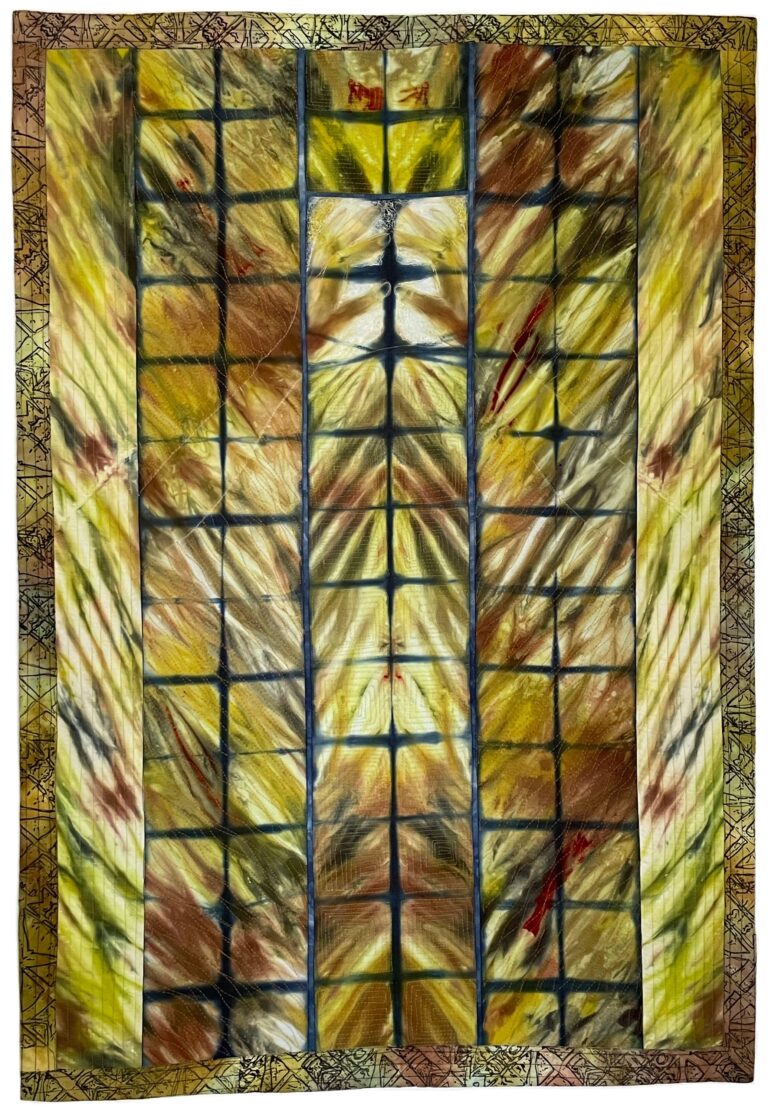
“Visions and Vistas”

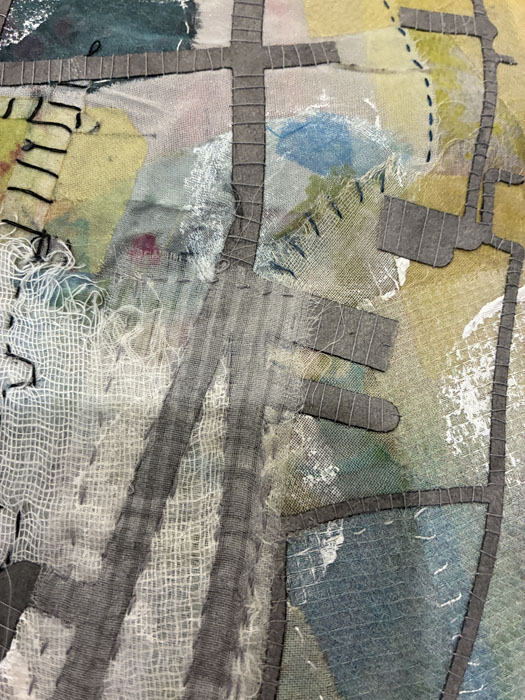
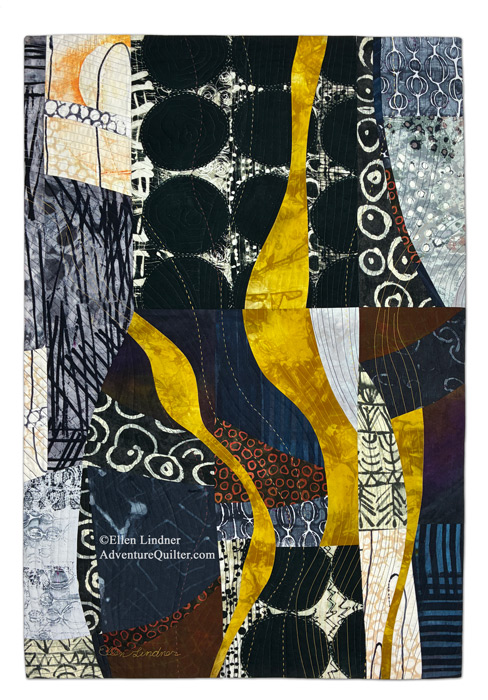
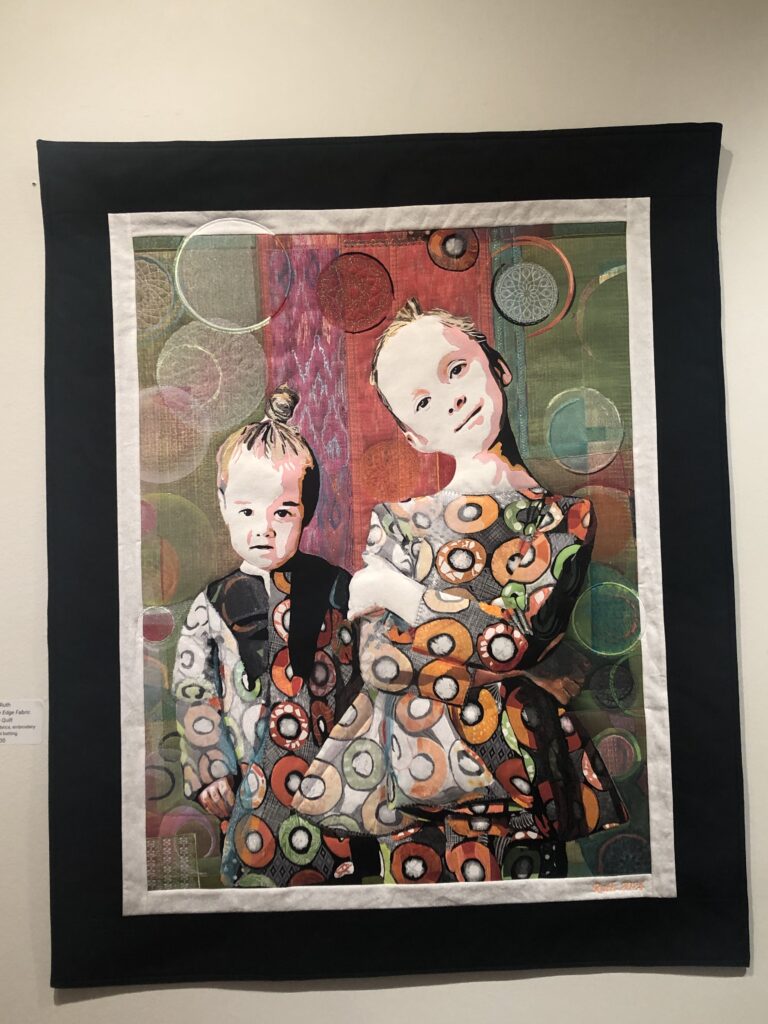
What do you get when you mix my colorful art quilts, the wonderful silk paintings of Jo-Ann Jensen, and a great venue?  Our current exhibit, Visions and Vistas.

Click image for a larger view

The exhibit space is the lobby gallery of our local performing arts center.  It shows off our work beautifully with good lighting and plenty of space.  Unfortunately, the gallery is only open during performances, but Jo-Ann and I have had fun arriving early to chat with the show patrons.  We’ve had some very interesting conversations and have received lots of compliments. 

Of course, most people are unfamiliar with fabric collage, so they’re very intrigued by my process.  It’s exciting to educate them about fabric as art.  (I don’t generally use the word quilt with non-quilters, since they tend to translate the word as “bedspread.”)

Jo-Ann and I are enjoying this collaboration so much we’re considering repeating it at other venues.

You can see all my exhibit pieces here.

Ellen Lindner

Post to Twitter

Courage in Ann Arbor

The ladies in my recent “Design Your Own Nature Quilt” class in Ann Arbor really rocked.

They set aside their fears about working loosely and forged bravely ahead.  (With a few hesitations, of course.)  The results were fabulous.  After only three hours of working on their compositions, these photos show just some of the results.

Norma cut loose – quite literally – with her quilt.  Although her inspiration photo showed the flowers from a variety of angles, she decided she liked this “full frontal” view the best.  (Great job being inspired by her photo, rather than owned by it.) 

Click any image for a larger view

I love the way she’s filled the space so effectively with these happy flowers.  Even the stems are dancing!

Carol worked from a busy garden photo and decided to depict her flowers somewhat accurately.  However, she took liberties with shapes and added a few new flower types to her exhuberant garden.

Carol will add lots of greenery in the foreground.  She’ll also add details to the flower shapes with colored pencils, thread stitching, etc.  It’s going to be a wonderful explosion of flowers!

Mary interpreted a photo of a mountain lake – with a mountain in the distance and a tree in the foreground.  She did a great job of working loosely, and her piece is progressing nicely.  Mary wisely interpreted the light and shadows in her picutre pretty accurately, so her quilt will have a wonderful depth to it.

Lori worked from a wonderful photo of delicate pastel flowers, all of them facing right.  She’s representing that correctly with the oval-like shapes of her flowers.  Once the flowers are complete, she’ll add an abundance of delicate diagnonal stems and a few buds.  It will be a delightful and peaceful quilt!

Paula’s photo depicted floating lily pads and a single flower.  Although it was tempting to use blue for her water, she realized that it actually looked dark gray in her photo.  She mimiced this with the perfect hand dyed fabric!

Normally, I’d suggest creating an image from the background foreward, which means Paula would have worked on her lily pads next.  However, we wanted to make sure the lily pad fabrics wouldn’t over power the delicate flower.  So, she created the flower first.  This reference will help with all her other decisions.  Doesn’t it look fantastic against the dark water?

Debbie’s photo featured closely cropped flowers with lots of tiny petals. (Zinnias, maybe?)  She wisely decided to create the flowers with large pieces of fabric, cutting the tiny petals only after the fabrics were placed.  Brilliant! 

Debbie has just started cutting those petals on the right flower.  Rather than just snipping the fabric, she’ll also cut away some tiny triangles.  This will give those petals the needed definition.  It’s going to be great!

Unfortunately, I didn’t get photos of all the pieces in progress.  They included a Tuscan landscape with fuschia, another lily, several more lake scenes, and other exciting compositions. 

It’s so much fun to teach this class!  I’m very fortunate to be able to do so.

Ellen Lindner
P.S.  I also teach this class online, but only about once a year.  If you’d like to be notified when it’s offered next, you can add your name to the distribution list near the bottom of this page.
P.P.S.  I’ll be teaching this class live in Jacksonville, FL in August, and Orlando, FL in September.  Full details


Post to Twitter

Apples in Ann Arbor

I recently had fun teaching Double Reverse Applique in Ann Arbor, Michigan. 

Click any image for a larger view

As usual, we had an awesome batch of apples by the end of class. 

It’s always great to see how different they all are.

Marilyn, Paula, Debbie #1, June, Brooks, Judy, Connie, Bertraud, Kaye, Marge, Debbie #2, Cindy, Rachel, and Janice did a great job!

We also had 3 pears completed by the end of class, including one blue one!

Update:  Marilyn sent me photos of her finished projects.  She added a little satin stitching around the edge of the pear, which I think sets it off beautifully.  Awesome!

My hostess, Lori, went way above and beyond the call of duty.  She drove me all over the place, fed me, and took very good care of me.  

Ellen Lindner

Post to Twitter

Seams Unique 2012 Exhibit

We’re lucky to have several small art quilt groups in my area.  One of them is Seams Unique, which has their annual exhibit currently on display.

The far wall of the exhibit space features a large sign and a small quilt from each of the members.  Several of these have really wonderful textures.

Click any image for a larger view.

One of the group challenges involved interpreting a painting in fabric.  These were very interesting, and amazingly well done.

The piece below is by Pam Chamberlain, representing Cassatt.

This one is by Andrea Luliak, inspired by Dali.

Susan Rienzo interepreted Matisse in this quilt.

 See what I mean?  Aren’t they great?

Another group challenge involved depicting a favorite location.  Vanya Neer did an exccellent job featuring the Sydney Opera House.

The Seams Unique exhibit is on display through March 31st at Boutique 4 Quilters, in Melbourne, FL.  Hope you get to see it!

Ellen

Post to Twitter

Awesome Student Work

I’m really enjoying working with the students in my current online class, Design Your Own Nature Quilt.  One of the items on the supply list for this class is “artistic courage,”  because the students often need to work outside their comfort zones. 

Click any image for a slightly larger view

The quilt above was made by Monica Spicker, and it’s entitled April in Amsterdam.  Her inspiration photo featured lovely tulips lit from behind.  Monica was inspired by the photo, but not owned by it.  (Our class motto.)  She altered the composition a little, and used value to both add depth and to create a focal point.  Isn’t it fantastic?

Martha Ginn made the quilt below, The Atrium at the Oschner’s.  She used several photos as her reference, creating her own unique composition.  Martha did an excellent job of getting her fabrics to do the work for her.  (Notice the vegetation throughout.)  Delightful!

I love the way these ladies, and the other students, have mustered their courage and moved forward, gaining new skills and confidence in the process.  I’m so proud of them!

Ellen Lindner
Resources:  Monica Spicker’s blog, Martha Ginn’s blog

Post to Twitter

Ready to Quilt – or Not (Croton Quilt)

Woohoo!  The quilt was finally pinned and ready to quilt!  I was quite happy with it.  I liked the colors and the contrasting veins.  Just my sort of thing.

Click any image for a larger view

But then, something started to bug me. 

Sometimes I say, “I hate it when I get a good idea.”  Why?  Because then I have to put in the effort to act on it.  Such was the case with this quilt. 

The large leaf on the right seemed sorta like it was springing from nowhere – even though it was consistent with the photo.  Did I really want to put in the effort to change it?  After all, the veins were glued in place and the underlying fabrics had been partially removed. 

But, I knew I had to do it.  I auditioned some changes on the computer and set to work removing the leaf.  See how the central orange leaf needs to be reworked, as well?

I rotated the base of the leaf a little and changed out the darkest fabric.  This is the result.  I’m much happier with it, even though the change is subtle.

Now, maybe I’ll actually get to quilt this puppy!

Ellen Lindner

Post to Twitter

When Visible Veins are Good (Croton Quilt)

After completing the leaves on my Croton quilt, it was time to move it from the design wall to the table.  This involves switching the pins from push pin mode to holding-fabrics-together mode. 

The photo below shows my progress at about the half way point.  The left portion has been freed from the design wall and is all pinned to the muslin.  It’s scrunched up so I can reach behind it to the next part, which is still secured to the design wall.

Click any image for a larger view.

Next, came the veins.  In the photo below I added blue veins to the leaf on the right.  LOVE the color contrast, but I wasn’t sure it showed up well enough.

I did the fuchsia leaf in the same fashion.  Not sure it showed well enough either.  When I got to the green leaf, I cut the fabrics so the veins were wider.

That definitely showed up better.  Which means I had to rework the first two leaves.  The photo below shows that, as well as the far left leaf done. 

Only the big orange leaf remains.  The photo above shows me auditioning vein colors.

All of this took much longer than expected!    Soon, though, I’ll be ready to start stitching.

Ellen Lindner
P.S.  Learn more about my collage and pinning technique here.

Post to Twitter

Final Croton Leaves

I’m winding down on the design phase of my Croton quilt.  Here it is with everything pinned in place – except for the vein fabrics.  (The fabrics aren’t really this bright, though.)

Click image for a larger view

I’ll add the vein fabrics by slipping skinny pieces of fabric under the adjacent larger pieces.  (It’s easier to hold everything in place with the little guys on the bottom.)  I’ll probably use a little glue to hold them in place.  And definitely LOTS of pins throughout!

My construction technique is rather unusual, I guess.  I don’t make a quilt top before stitching it to the batting.  Instead, I just leave everything pinned together, layer it with batting, and start stitching.  The stitches holds all the design fabrics in place, as well as adding wonderful texture.  

Ellen Lindner
P.S.  You can read more about my process here.

Post to Twitter

Zentangles with Shading

I’ve been researching Zentangles a little bit, and have found many online that I love.  I’ve noticed that many use shading to achieve a 3D dimensional.  This is very appealing to me, so I give it a try.

This is an early Zentangle, without shading.

Click any image to view larger

I tried adding some shading for depth.  It definitely helps, but I think I need to be more heavy handed.


To help me draw these designs, I decided to copy some from online sources.  I got several ideas from this site.  Like this one:  Isn’t it cool?  I love the way the “tentacles” go over and under each other.

Continuing on, I got this:  (Also copied from the website.)


But, there’s still room for more.  What about the background?  Plus, I think nearly all of the shading needs to be darker.

I’m DEFNITELY still learning:

Forget solitaire.  I think this will be my new time-filling activitiy.

Ellen

Post to Twitter

Croton Quilt: Adding More Leaves

I’m still enjoying working with my colorful croton quilt.  I’ve added a red leaf on the left.

Click any image for a larger view

I couldn’t decide whether the fuschia leaf or the orange one (center) should go in front.   I fully constructed each one, so I’d have maximum flexibility down the road.

A yellow-green leaf front at center adds interest.

Or does it?  I thought I could just work it loosely, for color.  But, I see that it’s going to need the full treatment.

Since the veins are not visible yet, I think it’s hard to tell which leaves are folded and which are open.  I auditioned a black edge to help with that, but have since decided against it.

Ellen

Post to Twitter