
Scrappy Inspiration?

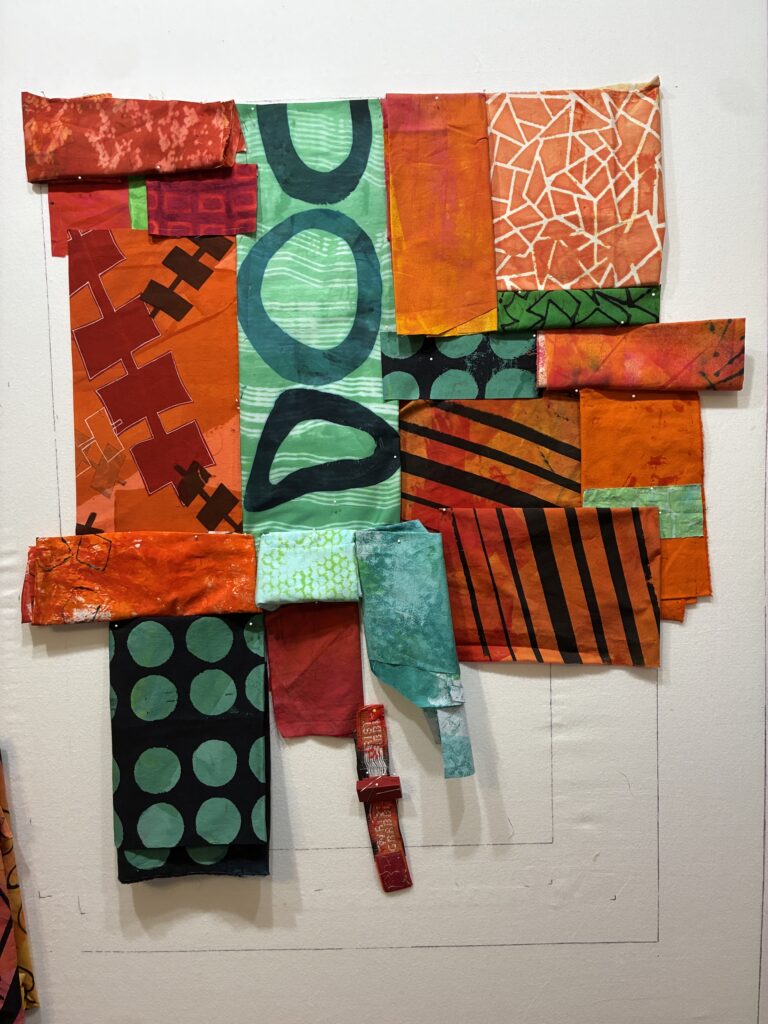
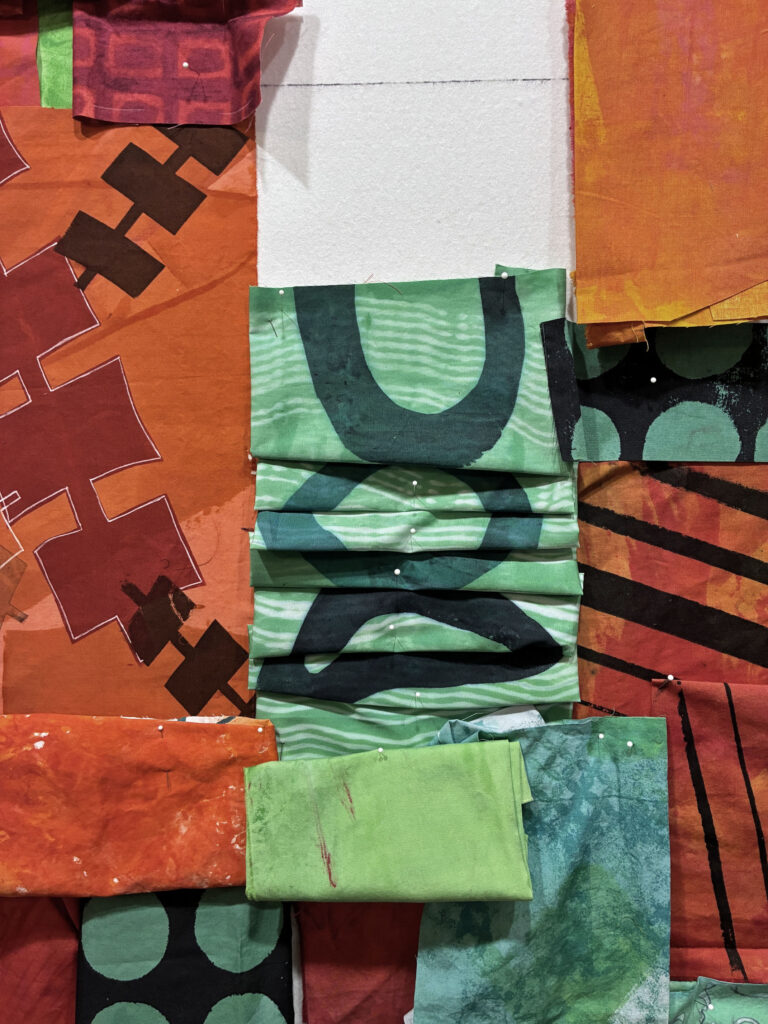
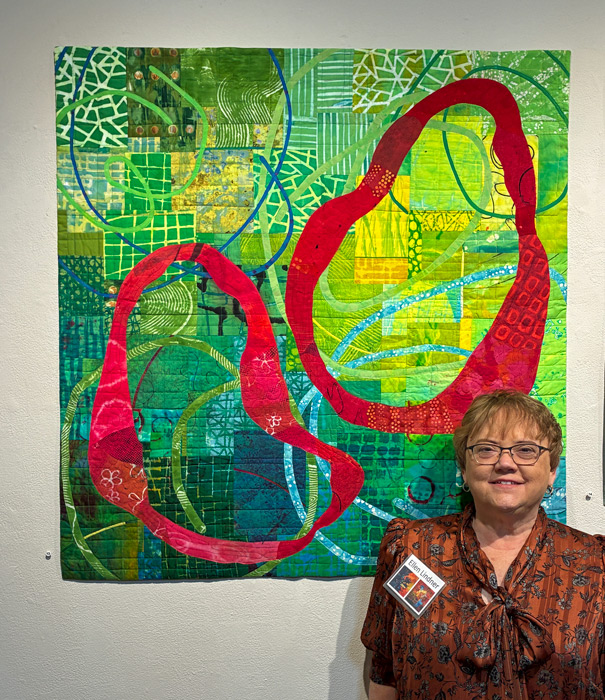
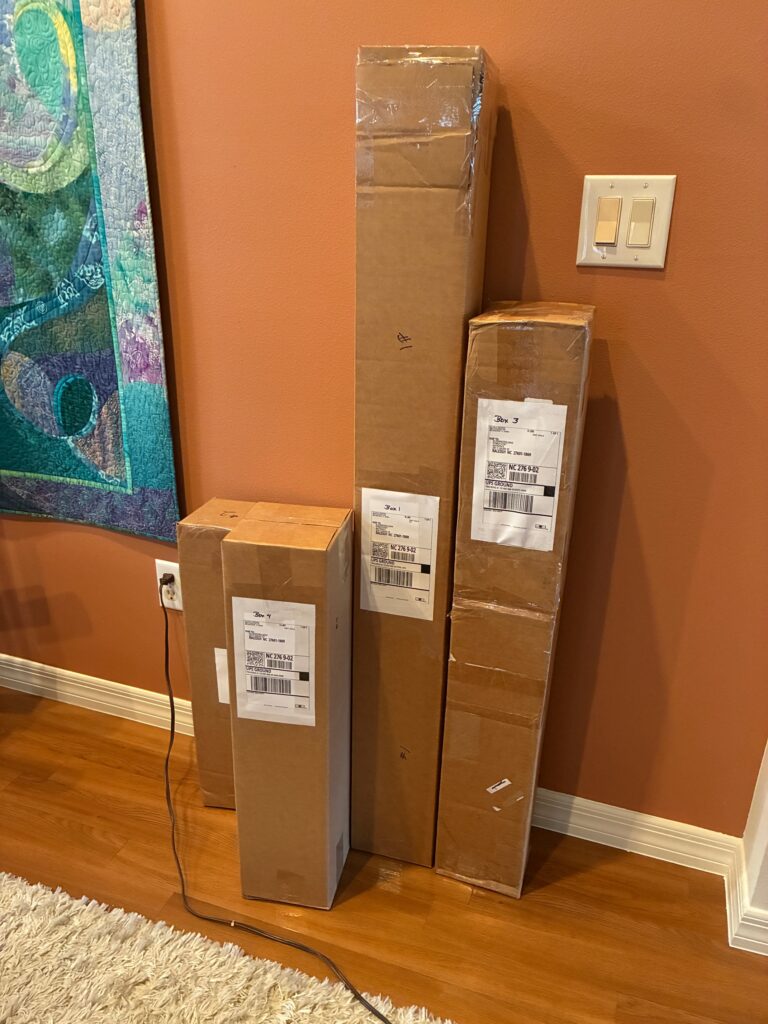
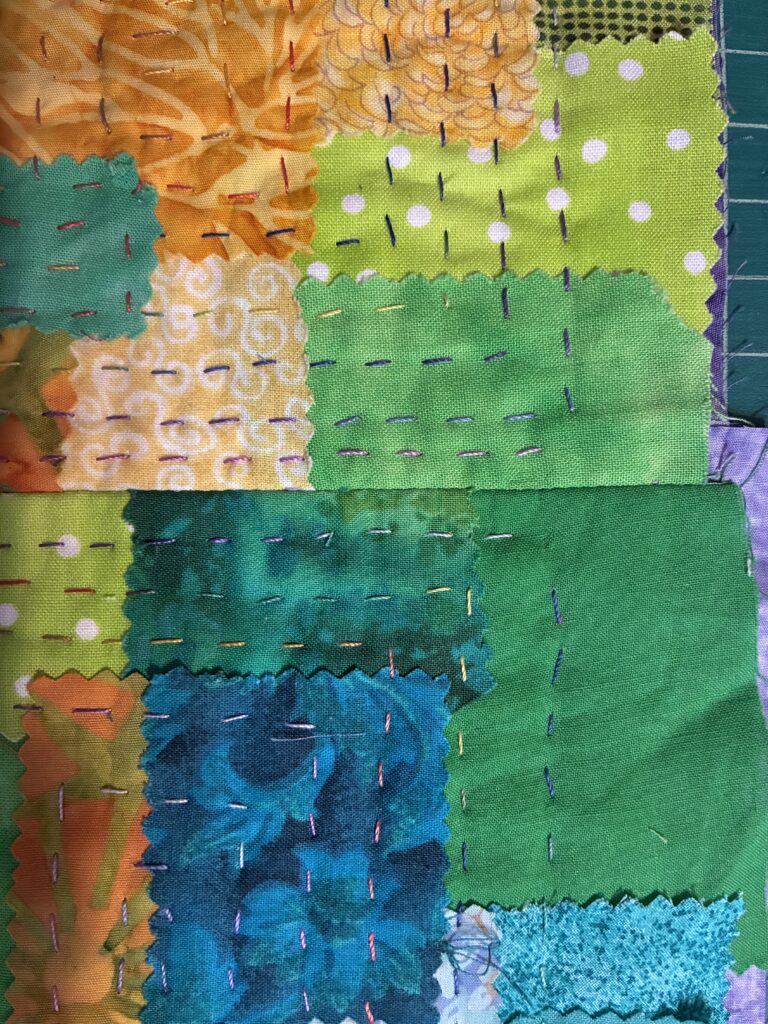
My latest quilt is larger than I normally make:  60″ wide by 40″ high.  This requires larger pieces of fabric, putting many more in the not-big-enough category.  I save the pieces that are larger than fist size, but I let the others fall to the floor.  It’s quite a colorful mess.

Normally, I don’t save these pieces.  After a project, I rake the carpet with my fingers and bag up these scraps for my friends.  They ADORE getting these!

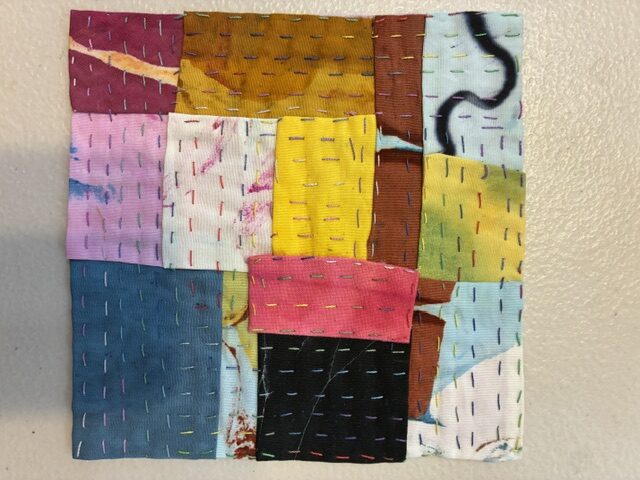
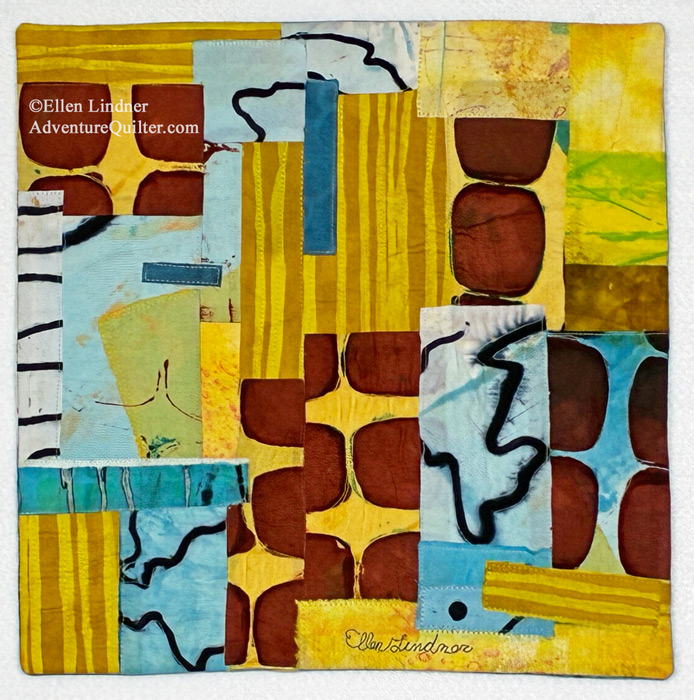
But, daggone it, these look really enticing don’t they?  I might have to change my ways and do something with them.  Something with a sort of confetti look?  I welcome suggestions.

Ellen Lindner

Post to Twitter

“Color Makes the Quilt”

What to do with a gorgeous piece of hand dyed fabric?  Back in 2003 my ideas were limited, so I decided to use it as a sampler for quilting designs.  But, it was just too pretty to be relegated to sampler status, so I added some more fabrics and created this, called Color Makes the Quilt.

Click any image for a larger view

This piece has been living in my UFO (unfinished objects) drawer since 2003.  I always thought it needed something more and I tried a couple of things.  But, they all seemed to detract from the lovely colors, so I finally left it as is.  (Detail shot below.)

I came across it recently and immediately knew what to do with it:  donate it to the small quilt auction at my guild’s upcoming show.  I often do this with samplers, old class samples, and the like, so this fit the bill perfectly.

Since 2003, I’ve come up with lots of things to do with hand dyed fabrics.  Here’s a photo of one I’ve been using a lot lately.

 As you can see, I no longer have any hesitation about cutting up these fabrics!

These days, one of my favorite things to do with hand dyed fabrics is to turn them into Instant Art Quilts.  With such quilts a gorgeous fabric is torn into pieces which are then rearranged.  This yields very interesting and wonderful results.  Like the one shown below, called Afterglow.

I teach a class in this technique, both live and online.  My students have great results and you can see their quilts here.   Plus, my own class samples.

Would you like to be notified when the next IAQ class is offered online?  If so, leave me a comment.  Your email address will show in my private email (but not publicly) and I can add you to my list.

Ellen Lindner
P.S.  I’ll also be teaching this class live in both South Carolina and Florida this spring.  Consult my teaching schedule for dates and locations.


Post to Twitter

Croton Quilt: Additional Leaves

Although croton leaves are very colorful, I’ve never really seen fuschia in them.  But that’s not slowing me down.  I’m definitely taking liberties with the colors.

Click any image for a larger view

I’m really liking the way this piece is coming together. 

I’m continuing to think about alternate vein colors.  Maybe lime green for the fuschia/red leaf?

Ellen Lindner

Post to Twitter

Croton Quilt: Getting Started

After a false start on my croton quilt, I selected new fabrics and was ready to go again.  I love these hand dyes.  And I think the addition of commercial prints makes the mix even better.

Click any image for a larger view

After deciding on dark blue as the background color, it was time to get started.  I layered irregular fabric pieces in place, leaving the muslin showing in areas where blue was not needed.  (See my inspiration photo here.)

I really enjoyed constructing the first large leaf.  I love the vibrant colors and way the veins add details.  I think I’ll try some unusual colors for the veins.  Maybe bright blue for this leaf.  (Click to see.)

I’m having fun!

Ellen Lindner

Post to Twitter

Selecting a Background Color

This is the photo I’m using as inspiration for my next quilt.  These vibrant colors really excite me.

But, I wasn’t too keen on the green/black background.  To audition options, I used my computer to isolate the foreground elements and tried a variety of background colors.  First, dark green.

Well, it matches my photo.  And it coordinates with the green found in these leaves.  But, it’s just not exciting me. 

To help show off the colorful leaves, I know I want a background color that is both dull and dark.  (Thus making the foreground attract attention with it’s lighter and brighter colors.)  What about black?

That’s certainly dramatic!  But, it doesn’t relate to the leaves at all.  Maybe I should go for an analagous (similar) color scheme.  Maybe a dark rust/burgundy.

Interesting.  Definitely viable, but not as much constrast as I’d like.  Finally, I auditioned the tried and true, a complementary color:  blue.

Wow, that’s a lot more dramatic than the previous one, isn’t it?  I kinda love this.  But, the black is pretty awesome, too.  Maybe I’ll use darker blues.  Still deciding.

None of these are right are wrong.  It’s all personal preference.  Which one is your favorite?

Ellen Lindner
P.S.  I have lots of articles on my website about color (and other topics.)
P.P.S.  You may have noticed that the compositions of the above images are slightly different.  I’m still playing with that, too.

Post to Twitter

Zentangles

Do you know about Zentangles?  They’re basically doodles within contained spaces.  You draw some large shapes, fill them in with small motifs, subdivide, and continue.

I tried my hand at one the other day.  First, I drew a lovely shape (which ended up being a complete waste of effort.)

 Then, I had fun subdividing and devising little patterns.

Until I got this.

There’s no real right or wrong way to do these, so I guess mine is successful.  I’ll definitely do more, but without so much thought at the beginning. 

Why not give one a try?  They’re fun and a good exercise in creativity.

Ellen Lindner

Post to Twitter

Size Matters (with prints, that is)

I recently started work on a fairly large quilt with colorful Croton leaves.

I auditioned fabrics that would help me achieve the striped effect of the heavily veined leaves.

Click any image for a larger view

Perfect, aren’t they?

Then, I drew one very large leaf onto muslin and cut it out as a base for the first leaf.

Great shape, right?

Then, I combined the two.

Ugh.  That’s when the wheels came off the bus.  Thankfully, I could tell right away that I had a problem, but it took me a little while to figure out why this was so bad.  Can you tell?

The problem was the scale of the striped fabrics.  They were just too small to work on this large scale. Although the stripes might work very well for a smaller leaf, they were actually an obstacle in this case.

Why didn’t I notice this issue when I auditioned the fabrics?  Because my audition didn’t show them in the proper scale.  A valuable lesson.

On to the next group of fabrics.  (Hand dyes:  MUCH better!)

Ellen Lindner

Post to Twitter

The Power of Stitching

I belong to a wonderful fiber art group, and we had our monthly meeting yesterday.  More like a “gathering,” really, with lots of show and tell, great ideas, some quilt critique, and lots of chatter.  Great for inspiration and creativity!

Bev O’Connell showed us some stitched flowers which were inspired by “Zentangle” drawings.  (More on Zentangle soon.)

These flowers are so vibrant and energetic! 

Click any image to see a larger version

Bev also showed us a sweatshirt with two more flowers on it.  I was struck by what a difference the decorative machine stitching made.  See what I mean:

The stitching really adds a lot of definition and interest, don’t you think?    Bev does great work.  (And she’s VERY prolific!)

Ellen Lindner

Post to Twitter

New Books for a New Year

I’m a sucker for books about art, design, color, and art quilting.  For Christmas, I received two that I think will be fantastic.  Adventures in Designis by Joen Wolfrom, and it’s written for quilters.  She wrote an earlier book, Visual Dance, which really taught me a lot.  I think this one will be similar, which will be a good thing.

Confident Color is written for all artists, by Nita Leland.  Although it includes exercises about mixing paint, the lessons are appropriate for fiber artists as well as artists working with any medium.  Once again, Nita’s earlier book, Exploring Color,  was my primary teacher on the subject.

 I’m looking forwarding to revisiting these topics with these authors.  It should be great for getting my 2012 creative juices flowing.

Ellen Lindner
P.S.  I’ve been doing a lot of left brain tasks lately and have found that my creative side has suffered somewhat.  I’m glad for books and thoughtful exercises to get me back on track.  (Or is it “off” track?  Maybe that’s more like it.)

Post to Twitter

Flower Arranging Basics

Would you like to learn the basics of making a fresh flower arrangement?   It’s very easy, and you only need a few tips and supplies to get started.

First, you’ll need a container.  Something the size of a cereal bowl is about right.

Next, you’ll need the key construction element:  Oasis floral foam  This green foam is sold in blocks at any craft store.  DO notice the type of foam you’re purchasing.  Oasis is designed to absorb water and you can press your thumbprint into it.  (Thre’s also a green foam used for arranging artificial flowers.  It looks more like Styrofoam and has no give.)

Cut the Oasis to fit your container.  Very important:  it should stick up above the top of the container about 1″ or so.  Completely submerge the foam in water, until it’s saturated.  (15 minutes or so.) 

Secure the foam in the container.  You may want to add some rocks around the edges to add support and weight.  Or purchase some floral tape and stretch it across in both directions.

Select flowers and greenery with stems that are somewhat sturdy, and with lengths that are suitable for your anticipated size.  My Christmas arrangement  is a simple triangle shape and that’s what I’ll show you how to do.  (Mine is mostly greenery, with a few berry clusters, but I’m giving instructions for a more traditional flower-filled arrangement.)

First, establish the height and width of the arrangement with greenery.  This is where the Oasis really comes in handy.  It allows you to insert stems horizontally.  Easy!

Next, add foliage at approximately 10:00 and 2:00 positions.  Let them lean forward and/or back, rather than being perfectly aligned. Add a few short pieces at bottom center, partially covering the foam.  (Yours will be fuller.  I’ve kept my sketch simple.)

Continue in this manner, adding greenery.  Add the first few flowers, in the approximate positions as the first three pieces of greenery. 

Continue filling in with flowers and additional greenery.  It often works well to place larger flowers near the bottom and smaller ones near the top.  If you have small filler flowers, such as Baby’s Breath, save them for last.  

Avoid having things too “perfect.”  Let it look natural, with some pieces closer to horizontal, others more vertical, some leaning forward, some back, etc

Water daily and enjoy!

Ellen Lindner

Post to Twitter